
Guide
How to Become a Nurse as a Career Changer: Pick Your Route First
How to become a nurse as a career changer: ABSN, ADN, BSN, or LPN first, how long each takes, what it does to your income, and 2025 BLS pay.
October 10, 2026 · 21 min read
On This Page
- How to Become a Registered Nurse: The Steps
- Which Route Fits You: Start From Where You Are
- How Long Does It Take to Become a Nurse?
- ADN vs. BSN: What the Exam Data Says
- LPN First, or Straight to RN?
- How Much Does It Cost to Become a Nurse?
- Getting In: Prerequisites, GPA, and Seat Shortages
- How Hard Is the NCLEX-RN?
- What Nurses Earn
- Is It Too Late to Become a Nurse at 30, 40, or 50?
- Frequently Asked Questions
- Is Nursing Your Next Career?
How to become a nurse, in short: you graduate from a state-approved nursing program, pass the NCLEX-RN, and get licensed by your state’s board of nursing. For a career changer, the choice that shapes the next one to four years is the first one, because the route you pick runs from about 12 months to four years. Many school pages open with the full ladder (nursing assistant, practical nurse, associate, bachelor’s, master’s) and end at “find a program.” That’s written for a high school graduate. If you already have a job, a mortgage, and maybe a degree in something else, the useful question is which single route fits where you are now.
For many career changers the exam is not the hardest step. In 2025, 86.7% of first-time, U.S.-educated candidates passed the NCLEX-RN (NCSBN). The harder ones are often getting a seat in a program and paying for a year or two with little or no paid work, and neither shows up on a program’s marketing page. If you’re still comparing nursing against other paths, our overview of second career ideas sets it beside ten others.
Key Takeaways
- A registered nurse (RN) needs a state-approved program, a passing NCLEX-RN score, and a state license. Your starting point picks the route: an accelerated BSN takes 12 to 18 months with a prior bachelor’s, an associate degree takes about two years, a four-year BSN takes four, and a practical nurse (LPN) program takes about one.
- The exam doesn’t separate the routes much. First-time pass rates in 2025 were 87.6% for bachelor’s graduates and 86.1% for associate graduates, but repeat takers as a group passed only 52.7% of the time.
- The cost most program pages leave out is what it takes to live while you study. AACN, the association of baccalaureate and graduate nursing schools, says accelerated students are “encouraged NOT to work.” At an assumed $4,000 a month of living costs, a 15-month program (our assumption) is $60,000, more than the $36,067 in-state tuition and fees one public university lists for its accelerated BSN.
- The BLS median RN wage was $97,550 in May 2025, against $64,400 for LPNs.
- None of the BLS or NCSBN material we reviewed sets an upper age limit for becoming an RN (confirm with your state board), and adult learners are part of nursing programs, but the national data on age at entry is thin. Treat any confident “average age” claim with suspicion.
How to Become a Registered Nurse: The Steps
“Registered nurses must have a nursing license issued by the state in which they work,” according to the Bureau of Labor Statistics. BLS lists no work experience or on-the-job training as a requirement. The sequence is the same in outline across states, though each state sets its own details:
| Step | What happens | Who controls it |
|---|---|---|
| 1. Complete a state-approved nursing program | Classroom and supervised clinical hours at a program your state board recognizes | Your state board of nursing, delivered by schools |
| 2. Apply to your state board | Application, fee, and, depending on the state, a background check | Your state board |
| 3. Pass the NCLEX-RN | A computer-adaptive licensing exam | NCSBN, with each state board deciding who may sit for it |
| 4. Receive your license | You can work as an RN in that state | Your state board |
One detail trips up career changers reading BLS: its summary lists a bachelor’s degree as the typical entry-level education, but the body of the page says RNs “usually take one of three education paths” (bachelor’s, associate, or diploma), and that licensed graduates of “any of the three types of education programs” qualify for entry-level staff nurse positions. So you can become an RN without a bachelor’s. What you give up is covered in the ADN vs. BSN section below.
Which Route Fits You: Start From Where You Are
Your starting point picks the route more than preference does. Someone with a bachelor’s in marketing and someone with a high school diploma and a decade in retail are not choosing from the same menu.

| Route | Best for | Typical length | The catch |
|---|---|---|---|
| Accelerated BSN (ABSN) | You already hold a bachelor’s in another field | 12 to 18 months, including prerequisites (AACN) | Typically a minimum 3.0 GPA, full-time, and students are “encouraged NOT to work” |
| Associate degree (ADN) | No bachelor’s degree, and you want the shortest route to an RN license | About two years, varying by program (SNHU) | Some employers, hospitals in particular, may require a bachelor’s |
| Traditional BSN | No degree and you can study full-time for four years | About four years (BLS) | The longest route; graduates of all three RN routes qualify for entry-level staff nurse jobs (BLS) |
| LPN/LVN first | You need a paycheck sooner and can accept a lower-paid license first | About one year (BLS) | Lower pay, and you’d need a separate bridge program to become an RN later |
Entry-level master’s programs, a fourth option for people with a prior bachelor’s, take “about 2-3 years” according to AACN. They end in a master’s degree and the same RN licensing exam, and they take longer than an ABSN, so for someone who just wants to be an RN the ABSN or ADN is the more direct route.
A rough decision rule: if you have a bachelor’s and can fund 12 to 18 months of near-zero earnings, look at an ABSN. If you don’t have a degree, or you can’t stop working that long, ask community colleges about their ADN schedules, including whether any are part-time, and compare them against a four-year BSN. If you need to be earning in a year, the LPN route is real, and we cover it below. None of this is a ranking. It’s matching the route to your constraints.
How Long Does It Take to Become a Nurse?
From about one year to four, depending on the route, plus whatever lead time it takes to get in.
| Route | Typical length | Source |
|---|---|---|
| LPN/LVN program | About 1 year | BLS |
| Accelerated BSN | 12 to 18 months, including prerequisites | AACN |
| Associate degree (ADN) | About 2 years, varying by program | SNHU; one community college’s ADN cost outline also spans two years |
| Entry-level master’s | About 2 to 3 years | AACN |
| Traditional BSN | About 4 years | BLS |
Two clocks sit on either side of those numbers. Before the program starts, programs set their own application deadlines and start dates, and missing one can mean waiting for the next cohort. After it ends, you still apply to your state board and schedule the NCLEX, and timing varies by state, so check your board’s page rather than a school’s. A path like therapist licensure runs on a similar multi-year clock if you’re weighing the two; our guide on how to become a therapist lays that one out.
ADN vs. BSN: What the Exam Data Says
Both routes lead to the same license and the same exam, and graduates of both pass it at similar rates. In 2025, first-time U.S.-educated candidates from bachelor’s programs passed the NCLEX-RN at 87.6%, associate-degree candidates at 86.1%, and diploma candidates at 83.3% (NCSBN, 2025 NCLEX Examination Statistics, Table 8).
Don’t read too much into 87.6 versus 86.1. Bachelor’s graduates passed 1.5 points higher, which is real but small, and it’s one year of data, not a controlled comparison: programs differ in who they admit. The takeaway is that an associate degree doesn’t carry a large exam penalty. Pass rates also swing by state, from 77.8% in Alaska to 92.9% in North Dakota in 2025 (NCSBN, Table 8), so one program’s own first-time pass rate tells you more than the national number.
The case for a bachelor’s is about hiring and advancement, not the exam. BLS says employers, particularly hospitals, may require a bachelor’s degree, and that a bachelor’s or higher is “often necessary” for administrative, research, consulting, and teaching positions. The BSN share is rising: NCSBN’s 2024 workforce study found that RNs first prepared with a BSN increased from 39% to 46% between 2015 and 2024 (NCSBN), so fewer than half of working RNs started with a bachelor’s in nursing.
RN-to-BSN completion programs exist for associate graduates who want the degree later, and one university’s program says a nurse transferring in the maximum 90 credits could finish in as little as a year (SNHU). Before you pick a program, ask the hospitals you’d like to work for what they require of new hires.
LPN First, or Straight to RN?
An LPN program takes about one year, and LPNs earn a median of $64,400 against $97,550 for RNs, a gap of $33,150 a year (BLS, May 2025). That gap is one reason people consider LPN first and bridge to RN later: they’re earning a licensed wage in about a year instead of waiting two to four. It’s a legitimate bridge when you can’t go 12 to 24 months without income.
The tradeoffs are real. You’d be earning about two-thirds of the RN median while you work and, if you want to be an RN, you’d still need to complete a bridge program. LPN-to-RN bridges exist at some schools, but we didn’t find a national figure for how long they take or how much credit transfers, so ask each program before you commit. BLS also projects slower growth for LPNs, 3% from 2025 to 2035, against 6% for RNs.
How Much Does It Cost to Become a Nurse?
Tuition is only part of the cost, and for a mid-career earner the income given up while in school can rival it. We couldn’t find a trustworthy national cost figure: the numbers on school and lead-generation pages come from sellers, and totals vary so widely by school and program type that any single figure would mislead. So here are two schools’ own published estimates, then a way to price your own version.
Both are estimates the schools publish themselves. Illinois State University lists $36,067.26 in in-state tuition and fees for the 62 nursing credit hours of its accelerated BSN sequence (2026 estimate), before books, uniforms, health and compliance fees, housing, and any prerequisites you still need. Pikes Peak, a Colorado community college, estimates $19,733.40 in resident tuition for the 56.5 credits of its ADN, and $29,591.70 all-in for a resident (fees, books, lab and clinical charges, exam and health costs) against $49,750.70 for a non-resident (2025-26). Residency alone moved that total by about $20,000, and a private university’s price would differ again.
AACN, the association of baccalaureate and graduate nursing schools, is blunt about the work side. Its fact sheet says students in accelerated programs “are encouraged NOT to work given the rigor,” and that financial aid for those programs “is limited” (AACN, 2025 data). Here is the arithmetic with the assumptions stated: if your household spends $4,000 a month on living costs and you spend 15 months in an ABSN with no paid work, that’s $60,000 before a dollar of tuition. Both the $4,000 and the 15 months are our assumptions, not statistics, and 15 months is a midpoint of AACN’s 12 to 18, not Illinois State’s published length, which we didn’t confirm. Set against Illinois State’s $36,067 in tuition and fees, the living costs come out larger. For a household that spends less each month, the comparison could reverse, so run the formula with your own numbers.
| Cost line | Where to get the real number |
|---|---|
| Tuition and fees | The program’s own published cost page, not a comparison site |
| Prerequisite courses | A community college catalog, if you still need them |
| Living costs while you’re not earning | Your monthly expenses multiplied by the months you won’t work; if you’d keep some income, subtract it |
| Licensing and exam fees | Your state board of nursing and NCSBN |
| Offsets | Scholarships, part-time work, and employer tuition support |
On that last line, AACN’s fact sheet notes that many practice settings are partnering with schools and offering tuition repayment to graduates as a way to recruit nurses. It’s worth asking hospital systems near you whether they sponsor cohorts or repay tuition, and what they’d require in return. If you’d rather earn while you train, becoming an electrician is a path built on a paid apprenticeship, which is the opposite structure from full-time unpaid study. Our decade-by-decade career change guide covers the savings side in more depth.
Getting In: Prerequisites, GPA, and Seat Shortages
Admission, not the exam, is the bottleneck for many career changers. AACN says accelerated programs typically require “a minimum of a 3.0 GPA” and a thorough pre-screening process. Applicants often need science prerequisites first. One university’s accelerated BSN page (Northeastern) lists “human anatomy and physiology, microbiology, statistics and chemistry” (check your target schools, since requirements vary), and the same page says its program accepts a non-nursing bachelor’s degree or at least 62 non-nursing college credits, so at least some programs take credits in place of a finished degree.
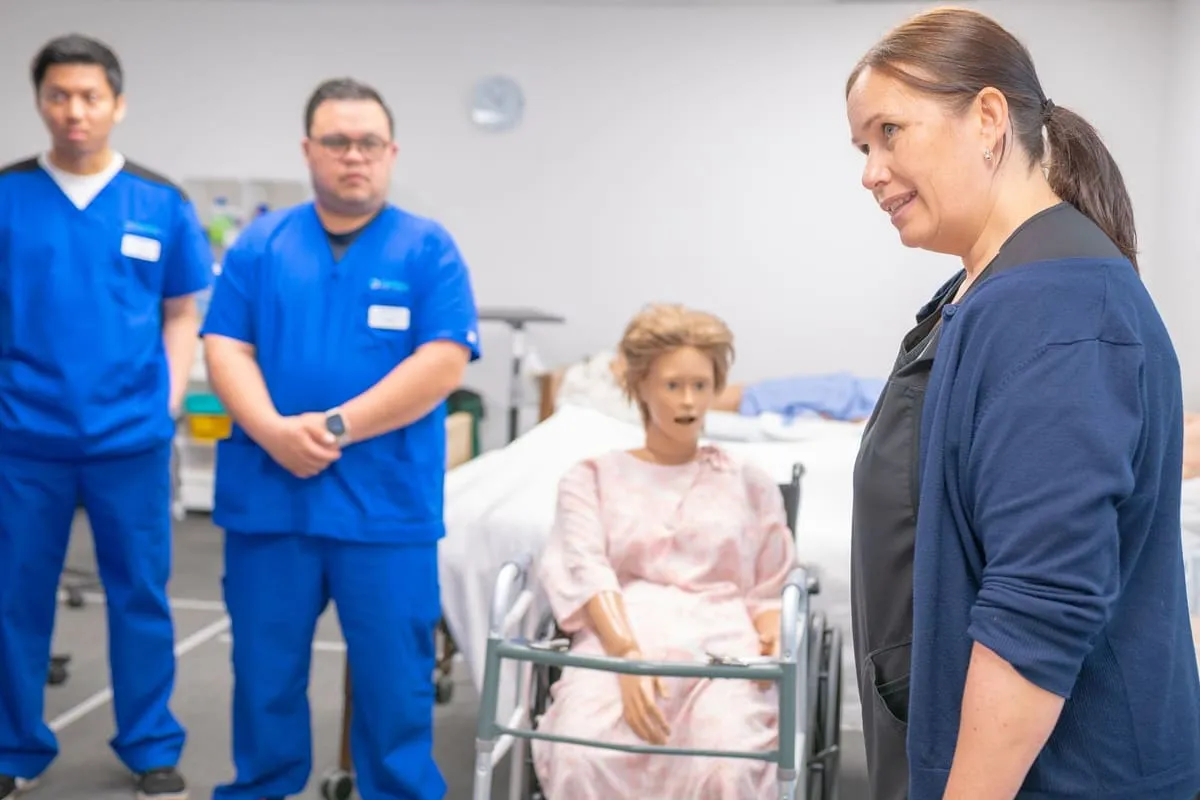
There are also more qualified applicants than seats. AACN’s fall 2025 survey counted 93,176 qualified applications (“not applicants”) that schools of nursing didn’t accept, citing “insufficient clinical placement sites, faculty, preceptors, and classroom space, as well as budget cuts” (AACN). Because it counts applications, one person turned away by several schools shows up several times, so it’s a measure of tight capacity, not of how many individuals were rejected. For a career changer, the practical plan is simple:
- Finish prerequisites with grades that clear the GPA bar before you apply, since the bar is a minimum, not a guarantee.
- Apply to more than one program, across more than one type if you can, because seat capacity, not only your record, decides some outcomes.
- Keep an ADN option open. A community college associate program can be the way in if a competitive ABSN doesn’t come through.
- Confirm the program is approved and accredited before you apply. Your state board decides which programs qualify you to sit for the NCLEX. Separately, ask whether the program is accredited by a body like ACEN or CCNE, which covers baccalaureate, graduate, and residency programs. ACEN says “many states mandate that a nursing program be accredited” and that students in institutions or programs accredited by an Education Department-recognized agency are eligible for federal financial aid.
How Hard Is the NCLEX-RN?
86.7% of first-time U.S.-educated candidates passed in 2025, and 52.7% of repeat candidates did (NCSBN, 2025 NCLEX Examination Statistics). The first number looks comfortable. The second covers everyone retaking the exam, including people on a third or later attempt, so it isn’t your personal odds. It does show that a retake is far from a sure thing, which is a reason to treat the exam seriously the first time.
The exam is computer-adaptive and runs 85 to 150 questions. In 2025 the average test was 103 items and took about 2 hours 14 minutes, within a five-hour limit. NCSBN launched the Next Generation NCLEX on April 1, 2023, so older advice and old study guides may not match today’s format. Two things worth doing: pick a program that publishes its own first-time pass rate, and schedule the exam soon after you graduate rather than letting the material fade.
What Nurses Earn
The BLS median wage for registered nurses was $97,550 in May 2025, or about $46.90 an hour. The lowest 10% earned less than $68,940, and the highest 10% more than $137,470.
| Measure | Registered nurses | LPN/LVN |
|---|---|---|
| Median annual wage, May 2025 | $97,550 | $64,400 |
| Lowest 10% earned less than | $68,940 | $49,740 |
| Highest 10% earned more than | $137,470 | $83,440 |
| Jobs, 2025 | 3,465,400 | 666,900 |
| Projected growth, 2025 to 2035 | 6% | 3% |
| Projected openings per year | About 180,800 | About 51,800 |
Source: BLS Occupational Outlook Handbook, Registered Nurses and Licensed Practical and Licensed Vocational Nurses.
“Do nurses make $100,000 a year?” The median is just under that and the top tenth is well over it, so it depends on setting, hours, and location, which BLS medians don’t break out. Treat $97,550 as a middle, not a promise. The same goes for what a new graduate earns: BLS reports a single median for all RNs, so a first-year nurse may start below it. Look up local postings.
Nursing pay is close to that of dental hygiene, a path that typically ends in an associate degree. BLS puts the median dental hygienist at $98,100, about $550 above the RN median, so the two pay about the same; our guide to how to become a dental hygienist compares the two. Advanced-practice roles such as nurse practitioner build on an RN license, and the healthcare section of our career-path framework shows how nursing fits into the wider industry.
One counterweight to the growth numbers: in NCSBN’s 2024 workforce study, 40% of RNs said they planned to leave the profession within five years, a figure the organization describes as “more informative than predictive” (NCSBN). It doesn’t mean 40% will leave. It does suggest that retention is worth asking about, so when you interview for a first job, ask about nurse-to-patient ratios and turnover on the unit.
Is It Too Late to Become a Nurse at 30, 40, or 50?
Probably not, though check your state board. None of the BLS or NCSBN material we reviewed sets an upper age limit for becoming an RN, and nursing programs have adult learners in them. What changes at 40 or 50 is the arithmetic: how many months you can go without income, and whether the physical demands of the job suit you.
We couldn’t find a national figure for the age people enter nursing programs, and we’d distrust any site that quotes one without a source. The nearest hard data is one state’s. Texas publishes RN graduate ages by band: for academic year 2024-2025, 31.0% of its 16,221 professional-nursing graduates were 31 or older (20.7% aged 31 to 40, 10.3% aged 41 and older), and 65.9% of LVN-to-ADN graduates were 31 or older (Texas DSHS, 2025 RN Student Demographics).
BSN programs skewed young: 61.0% of BSN graduates were 25 or younger. That’s one state, not the country, but it fits what AACN says about accelerated programs: its fact sheet calls the typical second-degree student “motivated, older,” with higher academic expectations than a traditional student. Separately, the NCSBN 2024 survey put the median age of the whole RN workforce at 50, which tells you the workforce is older, not that new entrants are.
The discussions people start before making this move are more mixed than the school blogs. A 39-year-old who works in water reclamation asked r/nursing about starting a second career in nursing and drew more than 110 replies, and a 40-year-old mother’s thread on whether nursing is a realistic career change at 40 drew more than 30.
The more useful threads ask what happens after: “2nd career nurses, was the grass actually greener?” has more than 230 comments, and a thread asking nurses whether they would change their career choice has more than 460, whose search preview shows a post that reads “I wish someone would’ve told me not to do nursing because I’m 6 months in and regret it.” These are individual stories, not data. Read the regret threads as carefully as the encouraging ones. Workload, staffing, and how the job compares to the one you left are the questions worth asking before you enroll.
A practical order of operations:
- Spend time in a care setting first. Volunteering or shadowing is our recommendation, not a requirement, and it’s the cheapest way to find out whether you want the work. A shorter route into healthcare, such as becoming a medical assistant, is another way to find out whether you like clinical work before you commit to a 12 to 24 month program.
- Price the runway before you apply. Fill in the cost table above with your own numbers, include health insurance for the school period, and don’t resign until you hold an acceptance and a funding plan.
- Compare two or three programs on first-time NCLEX pass rate and clinical placement, not just tuition.
- Ask each program what happens if a clinical placement falls through or you have to repeat a course. Find out whether it adds a term, adds tuition, or pushes your start date, because AACN names a shortage of clinical placement sites as one reason schools turn qualified applicants away.
Our guides to career change at 30, career change at 40, and career change at 50 walk through how age, savings, and risk interact.
Frequently Asked Questions
What is the fastest way to become a nurse?
A licensed practical nurse program takes about one year (BLS). For a registered nurse, an accelerated BSN takes 12 to 18 months including prerequisites if you already hold a bachelor’s in another field (AACN), and an associate degree takes about two years. “Fastest” depends on what you already have.
Do nurses make $100,000 a year?
The BLS median for registered nurses was $97,550 in May 2025, and the highest 10% earned more than $137,470. So the median is just under $100,000 and many nurses earn more, depending on setting, hours, and location.
Is it worth becoming a nurse at 40?
It depends on your runway and the job’s demands, not your age. Price 12 to 24 months of reduced income, spend time in a care setting before enrolling, and read the regret threads as well as the success stories. None of the BLS or NCSBN material we reviewed sets an age cutoff, but confirm with your state board.
How hard is it to become a nurse?
Admission is a hurdle: accelerated programs typically require a minimum 3.0 GPA, and AACN counted 93,176 qualified applications that schools did not accept in 2025. The exam is passed by 86.7% of first-time U.S.-educated candidates, but repeat takers as a group pass only 52.7% of the time.
Can you work while you’re in nursing school?
It depends on the route. AACN says students in accelerated programs are “encouraged NOT to work,” so plan on savings or other support. Some associate-degree programs may offer part-time schedules, so ask each school what it offers if you have to keep earning.
Is Nursing Your Next Career?
Nursing has several ways in, from a one-year LPN program to a four-year BSN, and a wrong choice can cost a year or two of income. The decisions that matter come before the school:
- Your route, set by your starting point: an ABSN if you hold a bachelor’s, an ADN or BSN if you don’t, or an LPN program first if you need income sooner.
- Your runway, because 12 to 24 months of reduced income can rival tuition, and financial aid for accelerated programs is limited.
- Your admission plan, since qualified applicants outnumber seats and programs set GPA and prerequisite bars.
- Your exam plan, since 86.7% pass the first time and repeat takers as a group pass at 52.7%.
The median RN earned $97,550 in May 2025. If you want a similar wage on a different training path, compare dental hygiene, or see our full second-career comparison, which sets nursing against ten other paths on cost, timeline, and pay.