
Guide
How to Become a Firefighter: Age Limits, EMT, and Timeline
How to become a firefighter: the hiring steps, why EMT comes first, how age limits differ by department, and how long it really takes to get hired.
September 28, 2026 · 21 min read
On This Page
- How to Become a Firefighter: Requirements and Steps
- Check the Age Limit Before Anything Else
- Who Pays for Training: Hired-Then-Trained vs. Certified-Then-Hired
- The Tests: Written Exam, Physical Test, and What Screens People Out
- How Long It Really Takes, From Zero to First Shift
- What Firefighters Earn
- The Volunteer and Wildland On-Ramps
- Is Firefighting a Good Career Change at 30, 35, or 40?
- Frequently Asked Questions
- So, Is This Your Path?
To become a firefighter you meet a department’s minimum requirements, earn an EMT certification, pass a written test and a physical ability test, get through an interview, background check, and medical exam, and then complete a fire academy. Most career departments use some version of that sequence, and you can find it on any city recruiting page.
The trouble is that the parts that decide whether you get hired are not on that list. They are set department by department, and the pages that rank for this question each describe only one department. Los Angeles has no upper age limit; New York City closes the door at 29. Some departments put you on payroll and pay you through their academy; others expect you to show up already certified, at your own expense. LAFD’s 2026 application window was open for about eight weeks; FDNY opens its exam roughly every four to five years.
This guide covers the common sequence, the three local variables that matter most to a career changer, what it costs under each hiring model, how long it takes from zero to a first shift, and an honest read on the pay. For how firefighting compares with other paths on cost and timeline, see our overview of second career ideas.
Key Takeaways
- The standard path: meet the minimums (usually 18 or older, a high school diploma or equivalent, a driver’s license), get your EMT, pass a written test and a physical test, clear the interview, background, and medical, then finish an academy.
- There is no national age limit. The Los Angeles Fire Department has none, federal “primary” firefighter jobs require you to be hired before your 37th birthday, Texarkana, Texas requires applicants to be under 36, and FDNY requires you to be under 29 when the application period opens. Check your target department’s cap before you spend anything.
- Cost depends on the hiring model. Boise pays recruits from the first day of its academy; Tampa wants a state firefighter certificate and an EMT card submitted with your application. Paying for that certification yourself costs about $2,800 to $4,100 for the academy at the two community college programs cited here, and more with EMT added.
- The median firefighter earned $59,280 in May 2025, about 15% less than the median for all U.S. workers. The top 10% earned more than $101,040.
- About 65% of U.S. firefighters were volunteers in 2020, according to NFPA. Volunteering is the cheapest way to find out whether you can do this work before you leave your current job.
How to Become a Firefighter: Requirements and Steps
The Bureau of Labor Statistics describes the baseline: applicants “typically must be at least 18 years old and have a valid driver’s license,” must pass “a medical exam and drug screening,” and complete “a few months of training at fire academies,” with some departments also requiring EMT certification (BLS Occupational Outlook Handbook, Firefighters). What the BLS summary cannot show you is the order, because each department sets it.
The Los Angeles Fire Department publishes one of the clearest versions, so it makes a useful worked example. Its selection process runs in eight stages:
| Step | LAFD stage |
|---|---|
| 1 | Minimum requirements |
| 2 | Online city application |
| 3 | Interview |
| 4 | Pre-employment and fitness assessment |
| 5 | Background investigation |
| 6 | Review of qualifications |
| 7 | Medical and psychological evaluation |
| 8 | Drug and alcohol screening |
A few specifics from LAFD’s own page are worth knowing. The minimum age is 18, with no upper limit. Applications are only accepted during a set window, which ran March 3 to April 30 in 2026. The fitness assessment is an 11-event physical test with a 9 minute 34 second limit. Your EMT or paramedic license has to be current by the background phase. LAFD also requires a written test, the Firefighter Candidate Assessment, covered in the tests section below.
After those eight stages come the academy and a probationary period, covered below. The order varies elsewhere. Texarkana, Texas, for instance, starts with a free, open competitive exam that ranks candidates on an eligibility list, and some fire academies will not accept you without a passed physical test card. Read your target department’s own notice rather than assuming this sequence.
Check the Age Limit Before Anything Else
There is no national firefighter age limit, and that is precisely the problem. Caps are set by each hiring authority, and in the four examples below they run from none at all to 29. If your target department’s cutoff is below your age, nothing else in this guide matters for that department, so this is the first thing to check.
Four employers show the range, each taken from the employer’s own published rules:
- Los Angeles Fire Department: no upper limit. LAFD requires applicants to be “at least 18 years of age at the time of application” and states plainly: “No upper age limit.”
- Texarkana, Texas: before your 36th birthday. The city’s civil service rules, revised March 23, 2026, require entry-level firefighter applicants to be at least 18 and not to have “attained their 36th birthday.”
- Federal wildland and other “primary” firefighter jobs: before your 37th birthday. Federal law lets agencies set a maximum entry age for firefighters (5 U.S.C. 3307(d)), and the Interior Department sets it at 37. Its Personnel Bulletin 12-16 fixes the maximum entry age for applicants without veterans’ preference at “the date immediately preceding the individual’s 37th birthday,” and its standard vacancy language exempts applicants with sufficient prior federal firefighting service and preference-eligible veterans.
- FDNY: before your 29th birthday, measured when applications open. According to JoinFDNY, you “must not have reached your 29th birthday by the beginning of the application period,” though veterans can subtract their time on duty from their age, up to 7 years.
Two details in those rules matter more than the headline numbers. First, when the cutoff is measured differs. FDNY checks your age when the application period opens, while the federal postings check it at appointment, which can come many months after you apply. Second, the exceptions are real. FDNY’s military credit means a 33-year-old veteran with five years of service counts as 28 and can still file, and federal postings exempt preference-eligible veterans.
The federal cap is tied to federal firefighter retirement coverage: 3307(d) borrows its definition of a firefighter from the federal retirement chapter, 5 U.S.C. 8331, which is what the posting’s phrase “primary covered position” refers to. Some departments, LAFD among them, have no cap at all. The only reliable way to know is the department’s own notice of examination or civil service rules. Do not rely on a third-party summary, including this one, for a department you plan to apply to.
Who Pays for Training: Hired-Then-Trained vs. Certified-Then-Hired
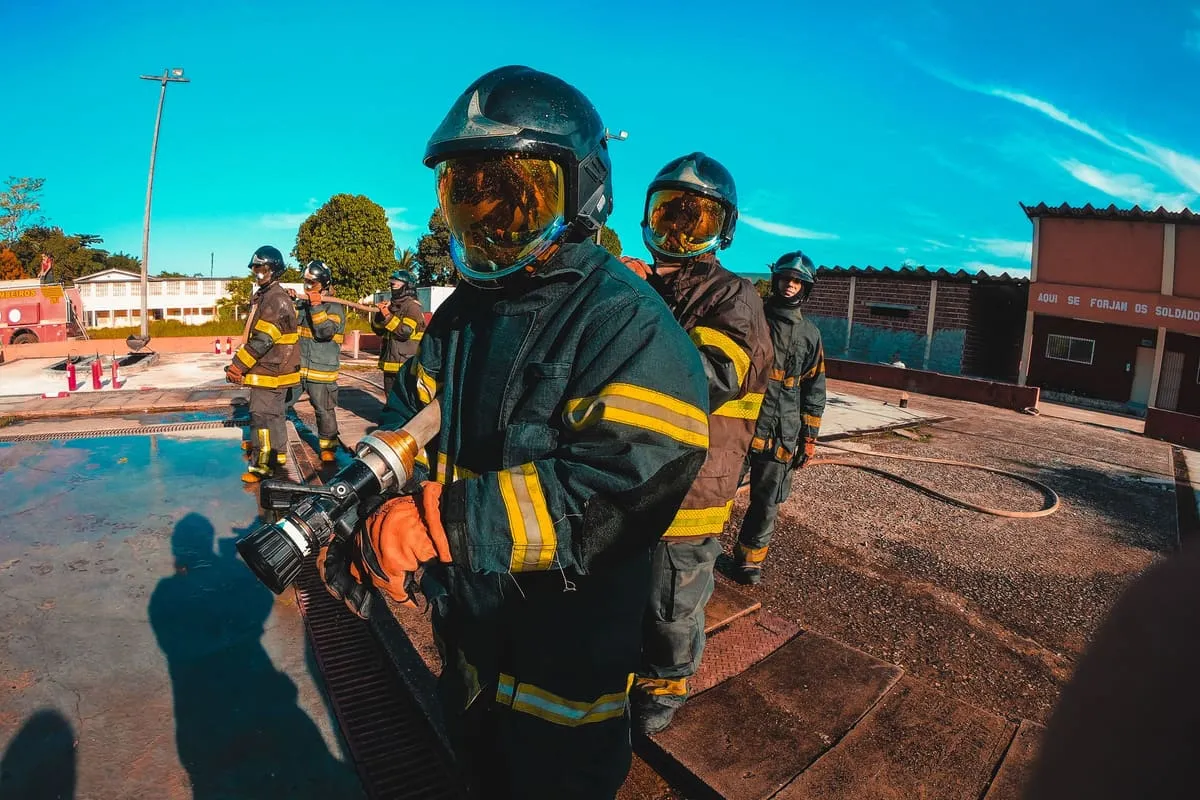
Departments train new firefighters in one of two ways, and which one you target changes your cost from almost nothing to several thousand dollars. The job posting’s minimum qualifications line tells you which kind you are looking at.
Hired, then trained. The department hires you as a recruit, puts you on payroll, and sends you through its own academy. Boise Fire’s entry-level FAQ is explicit: its recruit academy runs about 19 to 20 weeks full time and “is paid starting on the first day.” Texarkana hires academy trainees the same way (it also takes already-certified hires, covered below), starting their probation on the “date of employment as a firefighter academy trainee.” Even within this model, the EMT expectation varies. Boise wants a current EMT certification by the close of the application period, while Utah’s Unified Fire Authority says EMT “is not required at the time of hire” but must be earned during the new-hire probationary period.
Certified, then hired. The department expects you to arrive already certified. The City of Tampa’s July 2026 firefighter posting lists a current Florida Firefighter Certificate of Compliance and an EMT-Basic or paramedic certificate as minimum qualifications, and states that the firefighter certification “must be submitted at the time of application.” Hires then have three years to earn Florida paramedic certification. That certification often comes from a community college academy you pay for yourself. Two published examples:
- Collin College, Texas. The fire academy costs $2,764.60 for in-county students and $4,144.60 out of county. With EMT training added, the totals are $4,507.60 and $6,427.60. Some uniform items and equipment are extra.
- Bakersfield College, California. The Firefighter I academy runs about five months, four weeknights from 6 to 10 p.m. plus both weekend days from 8 to 5, roughly 34 hours a week on top of any day job. It costs approximately $3,500 for tuition, uniforms, and equipment. To apply, you must already have completed or be enrolled in the college’s EMT course and hold a current CPAT card. Applications are due by October 31.
Notice what the Bakersfield requirements imply: the self-funded route has its own gates before you ever reach a fire department. You need the EMT course and a passed physical test just to enter the academy that makes you eligible to apply.
Even departments that train you often expect you to pay for your own EMT. LAFD, for example, requires “a current EMT or paramedic license” by its background phase, and Boise wants it by the application deadline. The trade-off for a career changer runs like this: hire-then-train departments cost you the least, but you are competing with every candidate who has not paid for training either. Certifying yourself costs money and most of a year of evenings and weekends, but it widens the list of departments you can apply to, including ones like Tampa that will not look at you without it.
The Tests: Written Exam, Physical Test, and What Screens People Out
The written test measures general aptitude rather than fire knowledge, so preparation goes a long way. The physical test is trainable but unforgiving on the day, and the background check is the one gate you cannot study for.
Written aptitude test. LAFD’s Firefighter Candidate Assessment is “a required, 4-hour, computer-based test” measuring “learning ability, reasoning, reading and listening comprehension, and basic math.” It tests general aptitude, not fire science, so no one expects you to already know the job.
Physical ability test. Many departments use the CPAT. San Antonio’s fire department publishes the CPAT standard: eight events in a fixed order (stair climb, hose drag, equipment carry, ladder raise and extension, forcible entry, search, rescue, ceiling breach and pull), completed within 10 minutes and 20 seconds while wearing a 50-pound vest. On the stair climb you carry an extra 25 pounds for three minutes at 60 steps per minute. Not every department uses the CPAT. LAFD uses its own 11-event test with a 9 minute 34 second limit, and Texarkana’s includes a climb of a 70-foot aerial ladder and a crawl along 150 feet of charged hose wearing a blacked-out mask. Train for the test your target department actually gives.
On r/firefighter, a recent thread arguing that the CPAT stair climb is where people actually fail drew 30-plus replies. Read it as one community’s experience rather than data, but the logic holds up: it comes first, it lasts three minutes under 75 pounds, and it drains you for the seven events that follow.
Background check. Texarkana’s rules quote the Texas fire commission’s reasoning directly: because the public relies on “the honesty, trustworthiness, and reliability” of firefighters, “crimes involving moral turpitude, including but not limited to fraud and dishonesty, are directly relevant,” as is any history of alcohol or illegal drug use. The same rule singles out “the operation of emergency vehicles,” and Unified Fire Authority says applicants “should have a good driving record.” If something in your past might disqualify you, find the department’s written standards and read them before you pay for anything.
How Long It Really Takes, From Zero to First Shift
The academy is the short part. BLS describes it as “a few months,” and our second career ideas comparison lists firefighting at three to six months for that reason. For a career changer starting with no certifications, the honest timeline is longer, because the clock is set by application windows, not by training.
| Stage | How long | Source |
|---|---|---|
| EMT course | 16 weeks | Bakersfield College EMT program |
| Self-funded Firefighter I academy (if your target requires it) | About 5 months; applications due October 31 | Bakersfield College |
| Waiting for an application window | Weeks to years: LAFD’s 2026 window was about eight weeks; FDNY’s exam opens about every four to five years | JoinLAFD; JoinFDNY |
| Written test, physical test, interview, background, medical | Several months | Author estimate |
| Department academy | “A few months” (BLS); 19 to 20 weeks at Boise | BLS; Boise Fire |
| Probation | 18 months counted from the first academy day, or 12 months for hires already state-certified (Texarkana) | Texarkana civil service rules |
Added up, a realistic range for a career changer is about one to two years from starting an EMT course to working a first shift as a probationary firefighter. That is our estimate built from the stages above, not a published figure, and a missed window at a department that tests rarely can push it well past two years.
Probation is part of the timeline too, because you are not permanent until it ends. Texarkana’s 18-month probation for academy hires starts on the first day of the academy, so it includes the academy itself. Hires who arrive already state-certified serve 12 months, but they have already spent months in an academy on their own time and money. Self-funding moves the academy onto your own time and budget. It does not make the path shorter.
What Firefighters Earn
The median firefighter earned $59,280 a year in May 2025 (BLS). That is about 15% below the $69,770 median for all occupations in the United States. Recruiting pages rarely say so, and a career changer leaving a salaried job should know it going in.
| Measure (May 2025) | Annual pay |
|---|---|
| Lowest 10% | Less than $34,910 |
| Median, all firefighters | $59,280 |
| Median, local government | $59,850 |
| Median, federal government | $63,270 |
| Median, state government | $64,980 |
| Highest 10% | More than $101,040 |
| Median, all U.S. occupations (for comparison) | $69,770 |
Can firefighters make $100,000? Yes, but it is roughly the top tenth nationally, not the typical outcome. Pay varies enormously by department. Tampa’s July 2026 posting, for example, lists a range of $62,275.20 to $118,135.68, so the ceiling at a single department can sit well above the national 90th percentile. BLS counts 355,300 firefighter jobs in 2025 and projects 4% growth through 2035, with about 26,800 openings a year. Growth alone adds only about 1,300 jobs a year (13,100 over the decade), so most openings come from replacing people who retire or leave.
The practical point: the national median tells you almost nothing about the department you are targeting. Every public department publishes a salary schedule. Look up the actual starting step and the step you would reach after five years at the two or three departments you would apply to, and compare those to what you earn now.
The Volunteer and Wildland On-Ramps
Most American firefighters are not career firefighters. NFPA’s U.S. Fire Department Profile counted 1,041,200 firefighters in 2020, of whom 676,900 (65%) were volunteers and 364,300 (35%) were career. Only 18% of the country’s 29,452 fire departments were all-career or mostly career.
How to Become a Volunteer Firefighter
Because volunteer departments are so common, volunteering is the easiest low-risk test to find near you. You find out whether you can handle the physical work, the calls, and the disrupted sleep before you quit anything. Volunteer departments set their own rules, and some have no upper age limit; one r/Firefighting member noted that their local volunteer department has none, in a thread titled “How old is too old?” Ask your local department directly what training it provides and pays for, what call and drill commitment it expects, and whether its members have gone on to career jobs. Certifications and references earned as a volunteer carry into a career application.
How to Become a Wildland Firefighter
Wildland firefighting is a separate track. Federal wildland jobs are posted on USAJOBS, and the permanent “primary” positions carry the under-37 entry rule. As one example, a permanent GW-6/7 wildland firefighter job the Interior Department posted in September 2026 paid $57,670 to $81,343 and required passing “the work capacity test for arduous positions” before appointment. If you are 37 or older without prior covered federal service or veterans’ preference, look at state and municipal wildland agencies instead, which set their own rules.
Is Firefighting a Good Career Change at 30, 35, or 40?
At 30, usually yes, as long as the departments you would work for have no cap below your age. At 35 to 40, it depends almost entirely on where you apply and on your fitness. The people who have done it are more encouraging than the age table above might suggest.
The most useful discussion for this question is an r/Firefighting thread in which a 40-year-old asked firefighters who joined after 35 specifically about physical strain; it drew more than 90 replies. Similar threads ask whether 35 is too old and whether 32 or 33 is still a good age. That last one comes from someone who earned FF-1 and EMT more than a decade ago and then went into the trades as an electrician. If you are weighing the two paths, our guide to becoming an electrician covers the trade side.
Run the numbers for your own age against the employers above. At 36, Texarkana is already closed, and the federal primary track closes within the year unless you have veterans’ preference or prior covered federal service, because you have to be appointed before 37, not just apply. That shrinks a realistic list to no-cap departments like LAFD, plus volunteer services. Probation adds to that. In Texarkana, where it runs 18 months from the first academy day, someone hired at 35 is not permanent until about 36 and a half, even if they are hired on the first try. Ask any department on your list how long its probation runs and when it starts counting. None of that rules the career out. It does mean that from the mid-30s on, which departments you apply to matters more than how fast you can run the stair climb. If you are 30 and weighing this against other options, our guide to changing careers at 30 walks through the broader decision; at 40, see career change at 40.
A practical order of operations if you are over 30:
- Confirm the age cap and hiring model at two or three departments you would actually move to or commute to.
- Get your EMT first. Of the departments cited here, LAFD, Boise, and Tampa want it before hire, and Unified Fire Authority requires you to earn it during probation. It is also useful in healthcare work even if you are never hired; our guide to becoming a medical assistant covers another short clinical credential.
- Run a practice physical test for the specific test your target uses before you pay for an academy.
- Volunteer if you can. It is the cheapest way to confirm you want this.
Common Mistakes Career Changers Make
- Paying for a self-funded academy before checking the age cap and hiring model. Several thousand dollars spent on a certification the department you want does not require, or cannot use because of your age, is the costliest mistake available.
- Missing an application window. FDNY’s opens roughly every four to five years. Sign up for exam notifications at every department on your list.
- Treating the written test as the only hard part. The physical test and the background check are the gates that preparation cannot fully fix on the day.
- Using the national median to decide. Pull your target department’s salary schedule instead.
Frequently Asked Questions
How hard is it to become a firefighter?
The hiring is competitive, but each gate is knowable. The written aptitude test is passable with preparation, the physical test is trainable over weeks to months, and the background check is the one gate you cannot fix after the fact. The hard part for most career changers is logistics: an age cap, a missed application window, or a department that expects certifications you do not have yet.
Is 35 too old to become a firefighter?
It depends on the department. The Los Angeles Fire Department has no upper age limit. Federal primary firefighter jobs require you to be hired before your 37th birthday, with exceptions for prior covered federal service and preference-eligible veterans, and Texarkana, Texas requires applicants not to have turned 36. FDNY closes at 29, measured when the application period opens, with up to 7 years of credit for military service. Check each department you would apply to.
Can firefighters make $100,000?
Yes, but only about the top 10% do. BLS reports that the highest-paid 10% of firefighters earned more than $101,040 in May 2025, while the median was $59,280. Six-figure pay can come through large departments, overtime, or promotion to officer ranks; check a target department’s salary schedule to see where its top steps land.
Do you need to be an EMT to be a firefighter?
Usually, though the timing varies. BLS notes that departments may require EMT certification. Tampa wants it with your application, Boise by the close of the application period, and LAFD by its background phase, while Unified Fire Authority in Utah lets you earn it during probation. Bakersfield College will not admit you to its fire academy without EMT training completed or underway. Bakersfield’s EMT course runs 16 weeks, about one college semester.
How much does it cost to become a firefighter?
Close to nothing beyond EMT if a department hires you and then trains you, because the academy is paid work. If your target expects you to arrive certified, plan on a community college academy plus EMT: Collin College in Texas lists $4,507.60 for both for in-county students, and Bakersfield College in California lists about $3,500 for its academy alone. Collin’s figure excludes some uniform items and equipment; Bakersfield’s includes them.
So, Is This Your Path?
Firefighting is a public-service career that most career changers can enter in roughly one to two years without a degree, depending on the application window. The steps are the same almost everywhere. What differs, and what decides your odds as a career changer, is local:
- The age cap, which in our examples ranges from none to 29.
- The hiring model, which decides whether training costs you little beyond an EMT course or several thousand dollars.
- The application window, which may be open for a few weeks (LAFD’s 2026 window ran about eight) or only once every four to five years.
- The pay, where the median is modest and six figures belongs to the top tenth.
Check those four things at your target departments, get your EMT, and volunteer first if you can. If you are still comparing options, our full second-career comparison sets firefighting against ten other paths on cost and timeline.