

Guide
How to Become a Medical Assistant (Career Change Guide)
How to become a medical assistant: the real steps, what certification actually requires, and an honest comparison against becoming a CNA instead.
By John Davies
September 16, 2026 · 18 min read
On This Page
- How to Become a Medical Assistant: The Real Steps
- Medical Assistant or CNA? The Comparison Nobody Finishes
- What Medical Assistant Training Actually Costs
- What Medical Assistants Earn, and Where
- Before You Commit: Why People Leave This Job
- Is a Medical Assistant Job a Dead End?
- Common Mistakes Career Changers Make
- Frequently Asked Questions
- So, Is This Your Path?
Every guide to this career gives you the same four steps: finish high school, complete a training program, do a clinical externship, get certified. That sequence is accurate. It is also where most guides stop, right before the two questions career changers actually ask: is this different enough from becoming a CNA to be worth the extra time, and can you really skip the training program the way some ads imply?
Both questions have real, specific answers, not vibes. This guide covers the standard path, what certification actually requires from three different certifying bodies that do not all require the same thing, what the job pays against the nearest alternative, and why people who take this path tend to leave it. For how this compares with other credential-gated careers on cost and timeline, see our overview of second career ideas.
Key Takeaways
- The standard path: finish high school or a GED, complete a training program (9 to 12 months for a certificate, up to 2 years for an associate degree), complete a clinical externship, then get certified. Most states do not legally require certification, but most employers do in practice.
- Median pay is $45,690 a year (BLS Occupational Outlook Handbook, Medical Assistants, May 2025), about 8% above the $42,260 median for nursing assistants (CNAs), the career this path is most often compared against.
- You can get certified without a training program. The National Healthcareer Association lets candidates qualify by supervised work experience alone, 1 year within the past 3 or 2 years within the past 5, instead of a program. The flagship AAMA credential does not offer that route.
- A community college certificate typically runs $3,500 to $6,000; for-profit trade schools commonly charge $10,000 to $19,000 for the same CCMA-exam eligibility.
- Employment is projected to grow 13% from 2025 to 2035, well above the average occupation, driven by an aging population that needs more outpatient care.
How to Become a Medical Assistant: The Real Steps
To become a medical assistant you need a high school diploma or GED, a completed training program, a clinical externship, and a certification. That order is the standard answer you will get from most search results and career-school marketing pages, and it is correct as far as it goes. What it does not tell you is which parts are legally required and which are just what employers expect.
| Step | What it is | Typical duration | Legally required? |
|---|---|---|---|
| 1. High school diploma or GED | Minimum entry requirement for any training program | N/A | Yes, everywhere |
| 2. Training program | Certificate/diploma or associate degree, covering medical terminology, anatomy, basic labs, and office administration | 9 to 12 months (certificate), up to 2 years (associate) | No, in most states, but see below |
| 3. Clinical externship | Supervised hands-on hours in a doctor’s office or clinic, usually built into the training program | Weeks to a few months | Usually required to complete the program, not by state law |
| 4. Certification | A national exam: CMA (AAMA), CCMA (NHA), or RMA (AMT) | One test date, after eligibility is met | No in most states; yes in practice, since most employers screen for it |
Only a handful of states, including Washington and California, attach specific licensing or registration requirements to some medical assistant duties (mainly injections and certain delegated clinical tasks), and those rules are set at the state level, not nationally. Check your own state’s medical board or nursing board before assuming the national pattern applies to you, the same advice that applies to any healthcare occupation with state-by-state variation.
The Certification You Skip Matters: There Are Three, and They Are Not the Same
Most guides mention certification as one undifferentiated step. It is not. Three organizations issue the main credentials, and they set different bars for who can sit the exam:
- CMA (AAMA), from the American Association of Medical Assistants, is what the field treats as the flagship credential. The AAMA’s own certification page states its passing score is benchmarked to “an entry level medical assistant from a CAAHEP- or ABHES-accredited program,” and it does not offer a work-experience-only pathway. If you want this specific credential, you complete an accredited program first. There is no way around it. Check any program’s accreditation status directly in CAAHEP’s own program search before you enroll, the same way you would check a dental hygiene program against CODA’s directory.
- CCMA, from the National Healthcareer Association, is the most flexible of the three on paper. Per NHA’s own eligibility documentation, you qualify either by completing “a training program in the health field… offered by an accredited or state-recognized institution,” or through supervised work experience alone: one year within the past three years, or two years within the past five. Both pathways also require a high school diploma or GED, and prior U.S. military medical training counts toward the program requirement.
- RMA, from American Medical Technologists, sits between the two: it generally expects graduation from a CAAHEP- or ABHES-accredited program, or an equivalent combination of military training and work experience, rather than opening a pure work-experience route the way NHA’s CCMA does.
This is the honest answer to the “certified medical assistant without going to school” search: it is real for the CCMA specifically, through the work-experience pathway, not a loophole available for every certification, and not a route around needing a high school diploma or an employer willing to hire you into a supervised role first. For most career changers with no healthcare background, that chicken-and-egg problem, needing supervised experience to certify without a program, is exactly why the training-program route ends up being faster in practice than “for free” searches suggest.
Medical Assistant or CNA? The Comparison Nobody Finishes
This is the single most common fork career changers weigh before starting, and it shows up repeatedly in medical assistant and CNA forums, not as a passing mention but as the actual decision people are trying to make. The honest answer is that they are different jobs with different licensing chains, not two brands of the same entry-level role.
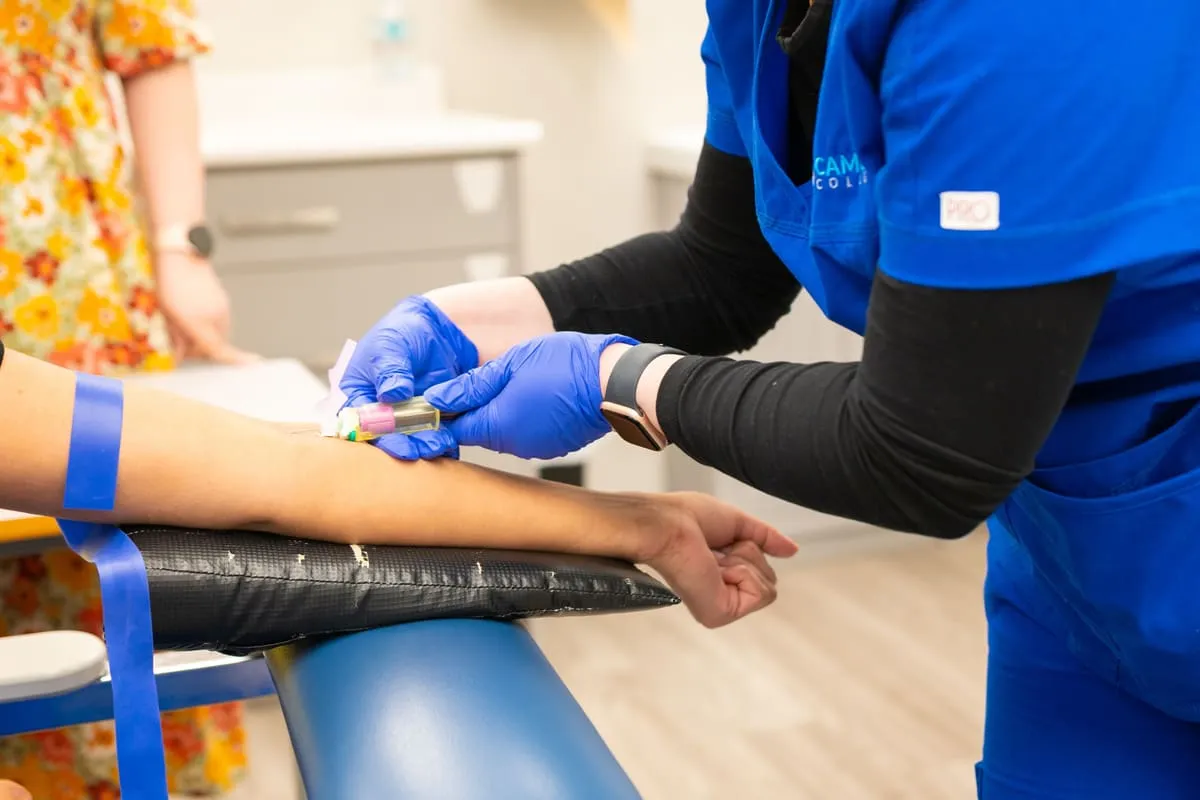
The scope difference comes down to whose authority you work under. Medical assistants are unlicensed personnel who act only on tasks a supervising physician delegates to them, a structure the AAMA documents state by state in its own scope-of-practice reference. CNAs work differently: they hold a state certification of their own and typically operate under a nurse’s delegation rather than a physician’s. One medical assistant summarized the practical split discussing the choice on Reddit: CNAs tend to work under the nurse’s license, while MAs work under the supervising physician’s license. That distinction drives most of the practical differences. CNAs concentrate on direct patient care (bathing, mobility, vitals) mostly in nursing homes and hospitals. MAs split time between clinical tasks (vitals, injections, EKGs, drawing blood) and administrative work (scheduling, billing, records) mostly in outpatient physician offices.
Training length is the other real divide, and it is a bigger gap than most comparisons let on:
A CNA program is genuinely the fastest route into a paid clinical role. Federal regulation (42 CFR 483.152) sets a 75-hour minimum for any approved nurse aide training program, and roughly 30 states plus DC require more, up to 180 hours in states like Maine; at a typical full-time pace that works out to about four to twelve weeks. One r/MedicalAssistant thread comparing the two paths put a similar number on it directly: CNA programs take about 6 weeks, against several months plus a clinical externship for MA programs. Treat that thread as color, not data, but it matches the direction of the regulatory minimum and the published MA program lengths above.
Pay tilts toward the medical assistant path, though by less than the scope difference might suggest:
Which one is “harder” depends what you mean. CNA work is more physically demanding day to day: direct patient lifting and personal care, in settings like nursing homes and hospitals, with heavier caseloads. MA training covers more ground academically, clinical and administrative skills together, and the credential opens more office-based, Monday-to-Friday roles. Neither is a strictly easier version of the other. They are different jobs that happen to sit at similar pay, and they get compared mainly because both are common entry points into healthcare without a multi-year degree. If your goal is nursing school later, either can work as a way to bank the patient-contact hours many programs want to see on an application; check the specific program’s own admission criteria for how it weighs that experience, since practices vary.
What Medical Assistant Training Actually Costs
A community college certificate is the value option. Northeast Texas Community College’s Certified Clinical Medical Assistant certificate runs $5,491 in-district for the 2025 to 2026 academic year, itemized as tuition and fees, a required review-exam fee, simulation lab fees, insurance and drug screening, and a course-materials subscription, before textbooks and a uniform. That is representative of the community college range generally, commonly $3,500 to $6,000.
For-profit trade schools charge substantially more for the same CCMA-exam eligibility. Bryan University lists its Clinical Medical Assistant Certificate at approximately $18,650 in total tuition, over three times Northeast Texas Community College’s itemized cost for what leads to the same certification eligibility. The gap is wide enough that the name on the diploma matters less for hiring than the total price you are asked to pay for it does for your finances; a CAAHEP- or ABHES-accredited community college certificate and an $18,650 for-profit certificate can lead to the identical CCMA eligibility.
Add certification exam fees on top, generally in the neighborhood of $150 to $200 depending on the certifying body and whether your program bundles it into tuition, and you pay the fee again on a retake, plus the uniform, stethoscope, and immunization costs every program lists as separate from tuition. Ask any program you are considering to confirm the current fee and whether it is included.
What Medical Assistants Earn, and Where
The median medical assistant earned $45,690 in May 2025, according to the BLS Occupational Outlook Handbook. The lowest-paid 10% earned less than $36,050; the highest-paid 10% earned more than $59,310. BLS counted 833,900 medical assistant jobs in 2025 and projects 13% growth through 2035, well above the average occupation, with about 109,700 annual openings, driven mainly by an aging population that needs more outpatient care.
Where you work moves the number more than most job titles in this field admit. BLS breaks out pay by industry: outpatient care centers pay the most at a $48,560 median, followed by hospitals at $46,910, physician offices (where most MAs actually work) at $45,520, and other health practitioner offices, including chiropractic and optometry, at $38,400. If pay is the deciding factor between two offers, the setting matters as much as the employer.

“What’s the highest-paying medical assistant job” usually resolves to two levers, not a secret specialty title: move to an outpatient care center or a hospital setting rather than a small physician office, and add a second, employer-valued skill on top of the base MA credential. Phlebotomy certification and EKG competency are worth prioritizing first: both are common add-on credentials that stack directly onto MA training without starting over, and both show up frequently enough in job postings for this role that they are a reasonable default if you are not sure which skill to add.
Before You Commit: Why People Leave This Job
Turnover in this field is genuinely high. A study of one academic family medicine practice found a 59% medical assistant turnover rate in 2017, published in the Journal of the American Board of Family Medicine, with a replacement cost of $14,200 per departure, about 40% of the average MA’s annual salary there. The same study noted that figure runs well above what turnover typically costs in other industries, which it put at around 20% of annual salary. That is one practice, not a national figure, but the direction matches what the field discusses generally: this is a job people cycle out of faster than most.
The pattern that shows up consistently is not that the clinical work itself is disliked. It is volume and interruption: high patient throughput compressed into short appointment slots, combined with the administrative half of the job (charting, insurance calls, scheduling) competing for the same hours as direct patient care. That combination, clinical duties and administrative duties both landing on one person with no separation between them, is specific to how this role is structured and is a genuinely different stressor than what drives burnout in a purely clinical role like nursing or a purely administrative one.
The practical version for your job search: ask a prospective employer how many patients are scheduled per hour, whether administrative work (calls, portal messages, prior authorizations) is assigned to MAs or to separate staff, and whether the practice is currently fully staffed. An office that has a dedicated front-desk or billing team, so MAs are not doing both jobs at once, is a materially different position than one that is not, at the same title and often the same pay.
Is a Medical Assistant Job a Dead End?
No, but it is also not automatically a stepping stone; that part depends on what you do with it. On its own, the MA role has a real ceiling: it is not a licensed clinical role, so it does not lead to expanded scope of practice through tenure the way, say, a nursing career does through additional licensure.
What it reliably provides is the kind of supervised, paid clinical exposure other healthcare credentials require as a prerequisite. That means hours toward nursing school prerequisites, a genuine first line on a resume for a physician assistant or nursing program application, and the work-experience pathway toward the CCMA discussed above if you started without a training program. Treat the MA role as either a destination you actively shape, by adding phlebotomy or EKG skills, moving to higher-paying settings, or specializing in a practice area such as ophthalmology or podiatry, or as a documented stepping stone toward a specific next credential. What tends to produce the dead-end feeling is taking the job with no plan for either.
The short training time is also what makes this path show up often in career change at 40 and career change at 50 planning: the investment is recovered quickly even if you treat the MA role as a plateau rather than a stepping stone, which matters more the less runway you have left to recoup a longer credential.
Common Mistakes Career Changers Make
- Assuming all three certifications have the same eligibility rules. The AAMA’s CMA requires an accredited program. NHA’s CCMA has a genuine work-experience pathway. Picking a certification target before checking its eligibility route wastes time.
- Comparing MA and CNA on pay alone. The bigger difference is scope of practice and setting, clinical plus administrative in outpatient offices versus direct patient care mostly in facilities, not the roughly 8% pay gap.
- Choosing a program on price alone. A $19,000 for-profit certificate and a $5,500 community college certificate can lead to the identical CCMA eligibility. Ask any program whether its graduates are eligible for the specific certification exam you want before enrolling, not after.
- Budgeting tuition only. Certification exam fees, a uniform, stethoscope, and immunizations land on top of whatever the program itself costs.
- Taking the first offer without asking about staffing. Patient volume per hour and whether administrative work is split off from clinical duties predicts whether this becomes a sustainable job more reliably than the posted wage does.
If you’re weighing this against a longer clinical path, our guide on how to become a nurse compares the accelerated, associate, and bachelor’s routes and what each costs in time and income.
Frequently Asked Questions
How long does it take to become a medical assistant?
Nine to twelve months for a certificate or diploma program, or up to two years for an associate degree, plus time to complete certification once you are eligible. The fastest route on paper, NHA’s CCMA work-experience pathway, still requires one to two years of supervised work experience first, so it is not actually faster for someone starting with no healthcare background.
Who gets paid more, a medical assistant or a CNA?
Medical assistants, by about 8%: a $45,690 median versus $42,260 for nursing assistants, both per BLS data for May 2025. The gap is real but modest, so pay alone should not be the deciding factor between the two paths.
What is the fastest way to become a medical assistant?
There is no true shortcut for someone starting from zero healthcare experience. NHA’s CCMA has a work-experience-only pathway, but it requires one year of supervised experience within the past three years, which itself takes as long as most certificate programs. For someone with no prior healthcare work, a certificate program with a built-in externship is typically the faster real-world route to a certification you can use.
Is a CNA the same as a medical assistant?
No. CNAs work under a nurse’s license and focus on direct patient care, mainly in nursing homes and hospitals. Medical assistants work under a supervising physician’s license and split time between clinical tasks and administrative work, mainly in outpatient physician offices. They are frequently compared because both are common entry points into healthcare without a multi-year degree, not because they are versions of the same job.
Can you become a certified medical assistant without going to school?
For one specific credential, yes. NHA’s CCMA allows certification through supervised work experience alone (one year within the past three, or two within the past five) instead of a training program. The AAMA’s flagship CMA credential does not offer that route and requires a CAAHEP- or ABHES-accredited program. Most states do not require any certification by law, but most employers screen for one in practice, so “no school” is realistic mainly for someone who can first get hired into a supervised role without it.
Is a medical assistant job a dead-end career?
Not inherently, but it does not advance on its own the way a licensed clinical role does. It works well as either a documented stepping stone toward nursing, physician assistant, or a specialty MA role, or as a destination you actively build out with add-on skills like phlebotomy and EKG competency. Treat it as a plan, not just a placement, and the ceiling stops being the problem.
So, Is This Your Path?
Medical assisting is a genuinely fast, genuinely affordable entry into healthcare: a community college certificate for roughly $5,500 and nine to twelve months of training leads to a job with a $45,690 median and 13% projected growth through 2035. The real decision most career changers are actually making is not “should I do this,” it is “this or CNA,” and the honest answer is that the two are different jobs with different licensing chains and similar pay, not a harder and easier version of the same role.
Get the certification eligibility right before you pick a program, since the three certifying bodies do not all require the same thing, and ask about patient volume and administrative load before you accept an offer, since that predicts whether this becomes a sustainable job more reliably than the posted wage does.
If you are still comparing options, our full second-career comparison sets this path against ten others on cost and timeline, and how to become a dental hygienist covers a comparable healthcare credential with a longer program but meaningfully higher pay.